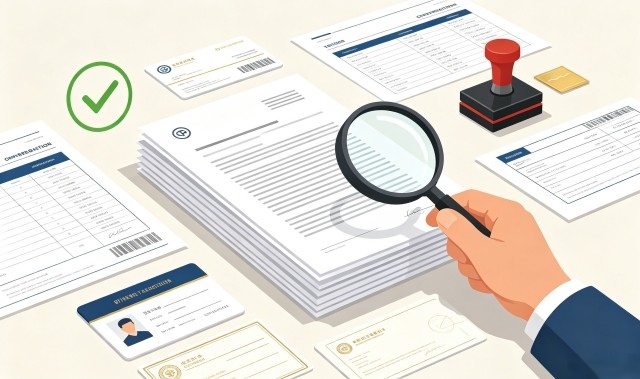
Unveiling the Truth: Advanced Commercial Credit Due Diligence in Global Trade

meticulously verified. Whether evaluating a potential acquisition, extending significant
credit terms to a new distributor, or forming a strategic joint venture, the financial and
operational health of the counterparty is paramount. Commercial credit due diligence
serves as the critical radar system in this landscape, allowing businesses to navigate beyond
glossy marketing materials and self-reported financial statements to uncover the true
operational reality of a potential partner. Unlike standard corporate establishment or general
trade compliance, commercial due diligence is a forensic exercise aimed at quantifying risk,
verifying solvency, and ensuring the long-term security of commercial engagements.
The Imperative of Independent Verification
The cornerstone of any robust due diligence process is the shift from passive document
review to active independent verification. In many jurisdictions, corporate transparency can
be inconsistent, and financial records provided directly by a target entity may be outdated,
overly optimistic, or, in worst-case scenarios, deliberately manipulated. Relying solely on
internal data exposes enterprises to severe counterparty risks, including supply chain
disruptions, unrecoverable debts, and reputational damage. A professional legal and
investigative team bridges this information gap by triangulating data from multiple
authoritative sources. This includes cross-referencing official government registries, analyzing
third-party credit reports, and conducting on-site operational audits to build a holistic and
objective profile of the target entity.
Dissecting Financial Health and Solvency Metrics
At the heart of commercial due diligence lies a rigorous analysis of financial stability and
debt repayment capacity. It is not enough to know that a company is profitable on paper;
investigators must assess the quality of its earnings and the liquidity of its assets. This
involves a deep dive into balance sheets to evaluate working capital ratios, cash flow
consistency, and leverage levels. Crucially, the investigation extends to verifying the status
of registered capital and paid-in equity. A company may boast a massive authorized capital
structure, but if the shareholders have not actually injected the promised funds, the entity’s
ability to absorb financial shocks is severely compromised. By scrutinizing bank credit
references and historical payment behaviors with other vendors, we can accurately predict
whether a partner will meet their financial obligations during economic downturns.
Uncovering Hidden Legal and Litigation Risks
A target company’s legal history is often a crystal ball into its future reliability.
Comprehensive due diligence requires an exhaustive search of litigation records, arbitration
proceedings, and administrative penalties. Frequent involvement in contract disputes,
particularly as a defendant in non-payment cases, is a glaring red flag indicating cash flow
problems or poor management integrity. Furthermore, investigators must look for
enforcement actions, such as frozen bank accounts or seized assets, which signal that courts
or regulatory bodies have already deemed the entity a credit risk. Beyond civil litigation, we
examine compliance with labor laws, environmental regulations, and tax obligations. A
history of regulatory infractions not only poses direct financial risks through fines but also
threatens the continuity of operations if licenses are revoked.
Mapping Ownership Structures and Related-Party Risks
Modern corporate structures are often intentionally complex, designed to obscure the true
individuals pulling the strings. A vital component of commercial due diligence is identifying
Ultimate Beneficial Owners (UBOs) and mapping related-party transactions. Credit risks
are frequently transferred between affiliated entities to shield assets from creditors or to
artificially inflate the revenue of a specific subsidiary. By tracing equity chains and analyzing
inter-company loans or guarantees, we can determine if a seemingly healthy target is actually
propped up by a failing parent company or a web of insolvent affiliates. Understanding these
connections is essential for drafting ironclad contracts that include cross-default clauses and
personal guarantees from the actual controllers.
Assessing Operational Reality and Market Reputation
Financial statements tell only half the story; the other half is written on the factory floor and
in the marketplace. On-site operational verification provides irrefutable evidence of a
company’s true scale and activity levels. Investigators visit registered addresses and
production facilities to verify the existence of inventory, the operational status of machinery,
and the actual headcount of employees. Simultaneously, we conduct commercial reputation
surveys by interviewing industry peers, former employees, and existing suppliers. These
qualitative insights often reveal critical issues that quantitative data misses, such as a toxic
corporate culture, high staff turnover, or a growing trend of delayed payments that has not
yet resulted in formal litigation.
Transforming Intelligence into Strategic Protection
The ultimate goal of commercial due diligence is not merely to gather information, but to
empower strategic decision-making. Based on the findings, we provide clients with a tiered
risk assessment and actionable recommendations. For low-risk partners, the path forward is
clear. For entities with moderate risks, we assist in structuring risk-mitigation mechanisms,
such as requiring letters of credit, implementing stricter payment milestones, or securing
collateral. In cases where fatal flaws are uncovered—such as fraudulent financial reporting or
severe insolvency—we provide the evidence needed to walk away from a deal before capital
is lost. In an era of volatile global markets, investing in thorough commercial due diligence is
the most effective insurance policy a business can buy.
Reference Resources
● Dun & Bradstreet (D&B) – Business Credit Reports: Global leader in commercial
data and analytics for assessing business creditworthiness and risk.
https://www.dnb.com/business-directory/company-research.html
● International Chamber of Commerce (ICC) – Know Your Customer (KYC): Guidelines
and tools for verifying the identity and creditworthiness of business partners.
https://iccwbo.org/publication/icc-guide-to-kyc-and-anti-money-laundering/
● World Bank – Doing Business (Archive & Data): Historical and current data on regulatory
environments and commercial laws across global economies.
https://www.worldbank.org/en/topic/doingbusiness
● Refinitiv (LSEG) – Risk Intelligence: Comprehensive platform for screening companies
against global sanctions, watchlists, and adverse media.